Is a mega El Niño coming in 2026?
Perhaps—but certainly not for sure. Why, then, do we hear such loud rumours about a “mega” El Niño?
To some degree, this is thanks to a broken system of public trust in science. A vacuum was left behind early last year in terms of advocacy, education, and decades of informed experience in seasonal prediction of Australia’s most important climate driver: the El Niño–Southern Oscillation.
A vacuum that any undergraduate in atmospheric sciences will know is quickly filled by the partial pressures of:
…opportunism, oversimplification, and loud voices unburdened by evidence.
In the absence of a trusted authority, the public conversation around ENSO does not quieten—it shifts. Headlines rush in to fill the space, often chasing attention long before the signs and the science are ready to speak. Without clear guidance, the urge to proclaim or predict becomes a race of its own, leaving many to piece together a story that once had a steady, experienced narrator.
When the Pacific Keeps Its Cards Close: The ENSO Predictability Barrier
The predictability of El Niño or its counterpart, La Niña, is particularly precarious when autumn sets in in the Southern Hemisphere. This is the well‑known predictability barrier, a stubborn feature of the climate system. During these months, the Pacific seems to hold its cards close, offering only weak signals and shifting patterns that refuse to settle.
Admittedly, there are currently growing prospects for an El Niño event to develop. Early signs of subsurface heat stored in the Pacific suggest that one necessary ingredient for El Niño may already be in place. Seasonal forecasts point to the possible onset of El Niño conditions in the coming months, following almost two years of weak La Niña conditions. The latest Niño 3.4 index predictions, which represent central Pacific sea‑surface temperature anomalies, show that most Australian ensemble members favor El Niño‑like warming.
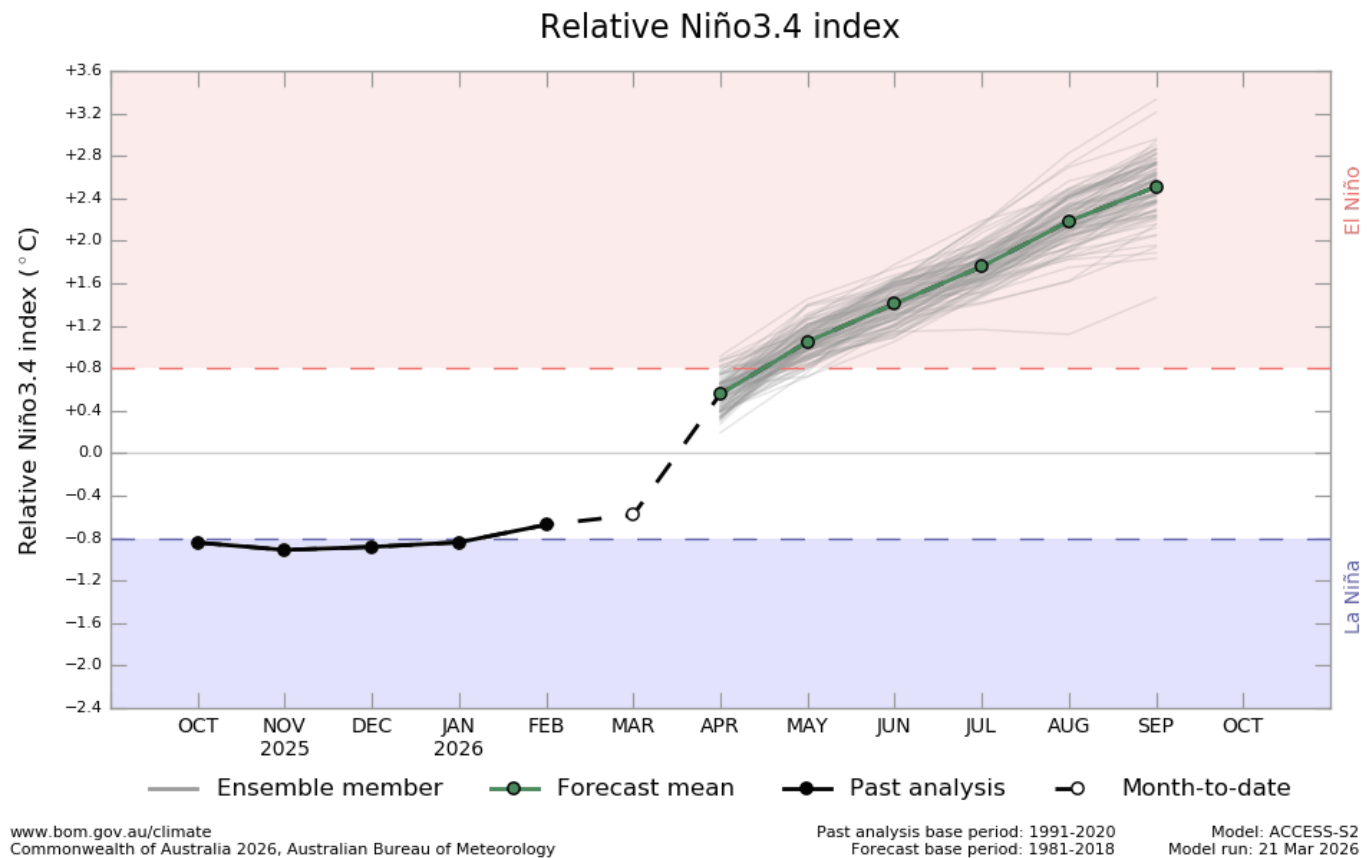
Subsurface heat , as we see now, may be building up, but without a clear atmospheric response it remains only one possible scenario. Likewise, changes in winds or pressure patterns may emerge, but they require support from the ocean before they can develop further. Until these components align and reinforce one another, the system remains in a transitional state, offering only limited insight into whether an El Niño or La Niña will emerge.
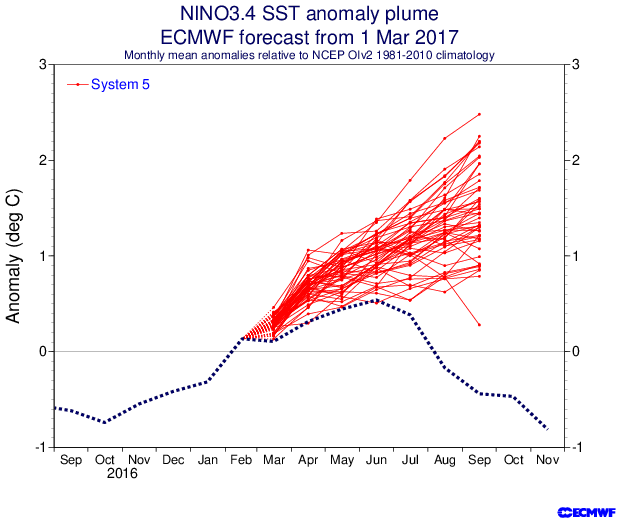
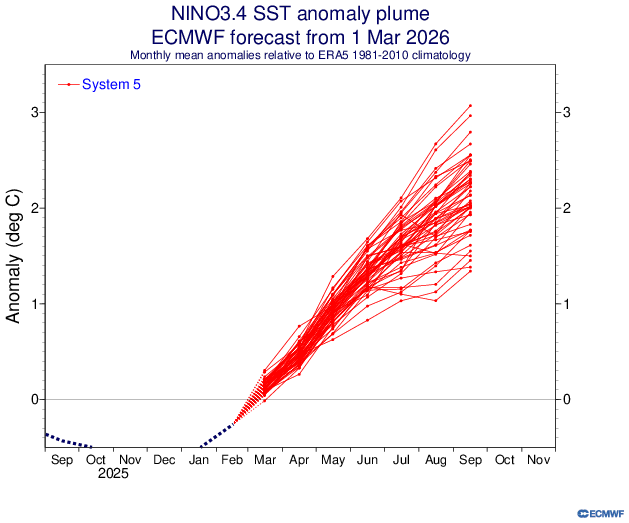
When we compare the current year (March 2026) with a past forecast initialized in March 2017, it becomes clear how predictions issued during autumn can evolve in very different directions. In 2017, the majority of forecasts (red lines) projected El Niño conditions for the 2017/18 season. However, the actual observations (dotted line) showed only a brief, weak positive excursion before returning to neutral conditions for the remainder of the year. Despite widespread model agreement, no El Niño ultimately developed.
Comparing the 2017 case with the current outlook for 2026 reveals some similar tendencies. As of March 2026, all ensemble members of the ECMWF forecast model point toward positive Niño 3.4 values. These projected anomalies are notably stronger than those seen in 2017, which may help explain the increased confidence surrounding the possibility of a “mega” El Niño—despite the persistent constraints imposed by the autumn predictability barrier.